

University
of Minnesota
Les Bolstad Golf Course
Turf Management Center
Superintendant Charlie Pooch answers your questions and gives tips on how we can help keep Les Bolstad a great place to play golf.
Have a question for Charlie? Send him an e-mail at uofmgolf18@uofmgolf.com
Why Aerify?
Aerification is a short-term disruption that has long-term benefits for the course. When you see them, remember that without those little holes, the greens would eventually die.
Like so many things, the quality of a good putting green is more than skin deep. In fact, the condition of a green has a lot to do with what goes on below the surface. In order to keep grass growing at 3/16-inch you have to have deep, healthy roots. Good roots demand oxygen. In good soil, they get the oxygen from tiny pockets of air trapped between soil and sand particles.
Over time, the traffic from golfers' feet (as well as heavy mowing equipment) tends to compact the soil under the putting green - particularly when the soil contains a lot of clay. When soil becomes compacted, the air pockets on which the roots depend are crushed, and the roots are essentially left gasping for air. Without oxygen, the grass plants will wither and die.
Aerification is a mechanical process that creates more air space in the soil and promotes deeper rooting, thus helping the grass plants stay healthy. In most cases, it's done by removing 1/2-inch cores (those plugs you sometimes see near a green or in fairways). The spaces are then filled with sand "topdressing" that helps the soil retain air space and makes it easier for roots to grow downward.
Frost Delays
A footprint can be a killer when it's a footprint made on a putting surface that's covered with frost. Though it may be hard to believe that walking across a golf green can cause so much damage, the proof will be visible in a couple days when the turfgrass dies and leaves a trail of brown/black footprints. This is why we delay times until the frost is melted away. And it's also why golfers who appreciate a quality putting surface will be patient during these delays.
Frost causes problems because a putting green is a fragile living thing. It is an environment that must be managed carefully and professionally. Every green is a collection of millions of individual grass plants. Obviously Mother Nature never intended for these plants to be maintained at 3/16 or even 1/8 of an inch for prolonged periods. This stress makes greens constantly vulnerable to attacks from insects, disease, heat, drought, cold - and frost.
Frost is essentially frozen dew. It can form when the temperature (or wind chill) is near or below the freezing point. the ice crystals that form on the outside of the plant can also harden or even freeze the cell structure of the plant. When frosted, the normally resilient cells become brittle and are easily crushed. When the cell membranes are damaged, the plant loses its ability to funtion normally. It's not much different than cracking an egg. Once the shell is broken, you can't put it back together.
Although you won't see any immediate damage if you walk on frosted turf, the proof will emerge within 48-72 hours as the leaves die and turn brown. And, since just one foursome can leave several hundred footprints on each green - and fairway - the damage can be very extensive.
This damage isn't just unsightly - putting quality will also be reduced until repairs are made. Those repairs are expensive, and in some cases, the green may have to be kept out of play for days or weeks until the new turfgrass is established. A short delay while the frost melts can preserve the quality of the greens, prevent needless repairs, and may even save you a few strokes the next time you play.
Fixing Divots
If you play golf, you create divots -- it's part of the game. However, if you create divots, you should also repair them -- that's part of the etiquette of the game. Repairing your divots ensures that the golfers who follow you have the same level playing surface you had when you started your round.
It's very simple to replace a divot. To do this, you should replace it in the same direction that it came out and firmly tamp it down.
Repairing Ball Marks
Ball marks, those indentations caused when a ball lands sharply on a soft green, have been ruining good putts since the days of Old Tom Morris. Unrepaired ball marks take two to three weeks to properly heal, leaving behind unsightly, uneven putting surfaces. On the other hand, a repaired ball mark only takes half that time to heal.
Beginner or pro, it is your responsibility as a golfer to fix your own marks. If you're truly a steward of the game, you'll fix any others you see while your partners are putting. There's really not much to it, but there are a few guidelines you should follow when making these repairs


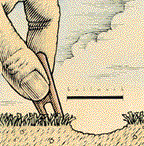
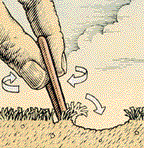
Use a pronged ball mark repair tool, knife, key or tee.
Insert it at the edges of the mark -- not the middle of the depression.
Bring the edges together with a gentle twisting motion, but don't
lift the center. Try not to tear the grass
Smooth the surface with a club or your foot. You're done when it's a surface you would want to putt over.
